
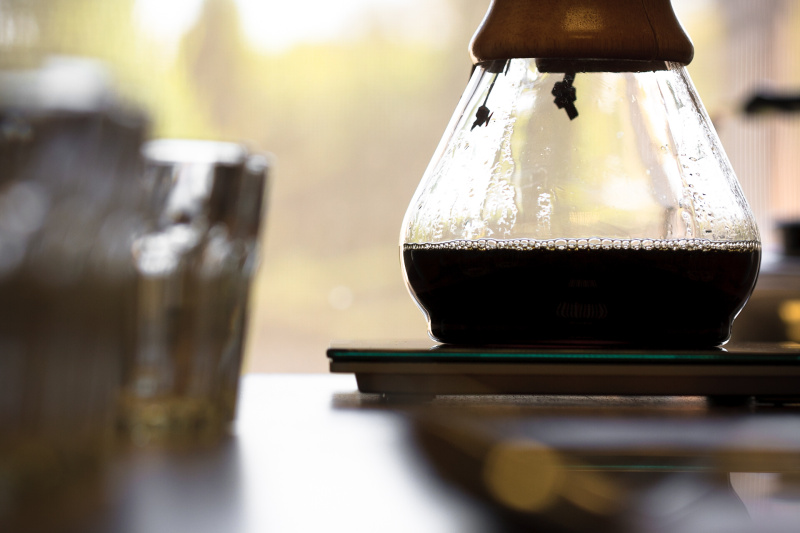
If the terms “stylish” and “full-control” tickle your attention, the Chemex may rapidly become your favorite coffee brewing tool.
It was created in 1941 and is still widely used today. The major reason is because it produces excellent coffee.
But also because of its appealing look and ease of use in making coffee while retaining total control over the process. Those who want to watch their coffee brew will adore the Chemex.
Design and Build
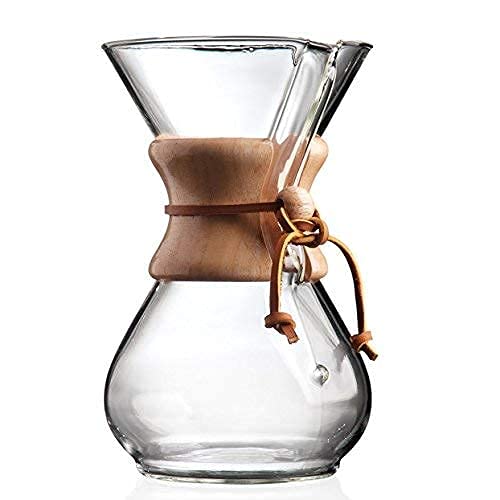
It’s an hourglass-shaped glass brewer that allows the brewer to see the entire process. The original design has a wooden handle in the center, while the Glass Handle design, which is more modern, has a glass handle instead.
The wooden handle comes in a range of colors. Both variants have a cowhide thong attached to the handle.
The Chemex is so beautiful and trendy that it was featured in New York City’s Museum of Modern Art. The Chemex deserves to be a part of the rich history of art and coffee.
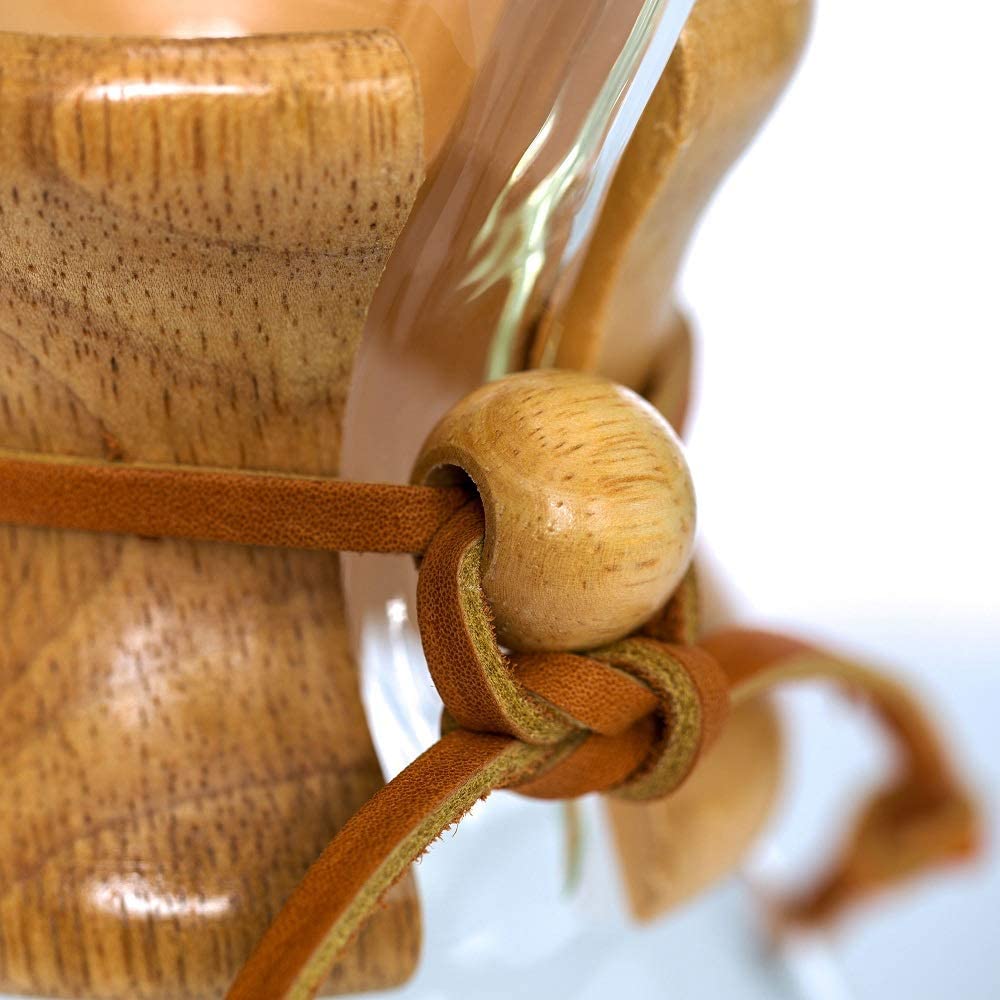
Light can travel through the Chemex since it is composed of borosilicate glass. It can endure high temperatures and is easy to clean.
The combination of the wooden or glass handle makes it visually beautiful on its own, but much more so while brewing coffee. It’s both a work of art and a coffee maker.
Brewing Hot and Cold
The process of brewing with a Chemex is both simple and difficult. The Chemex is categorized as a pour over. A brewing apparatus that pours hot water over ground coffee, which is then filtered in some way and collected at the bottom.
Then the coffee is ready to drink.
The majority of this equipment requires no energy at all. They are portable and easy for brewing coffee anywhere, but they cannot keep it warm.
The majority of coffee experts consume their coffee in a few of minutes. And certain brewers, such as the Chemex, are built for this sort of quick consumption.
But how does brewing with a Chemex actually work? You’ll need a few materials, as well as your favorite coffee beans, to brew using it:
- A weighing scale for precisely calculating the coffee-to-water ratio.
- A grinder, which is used to ground the coffee beans just before brewing.
- A kettle, particularly one with a gooseneck, to perfectly orient the pouring of hot water over the coffee Chemex’s bonded filter, which is specially created for this coffee maker.
- A thermometer may be useful if you want to know the precise temperature of the water and recreate the resultant coffee the following time.
Brewing with a Chemex allows for last-minute alterations throughout the brewing process, making it especially versatile. There are various methods for brewing the ideal cup of coffee using a Chemex.
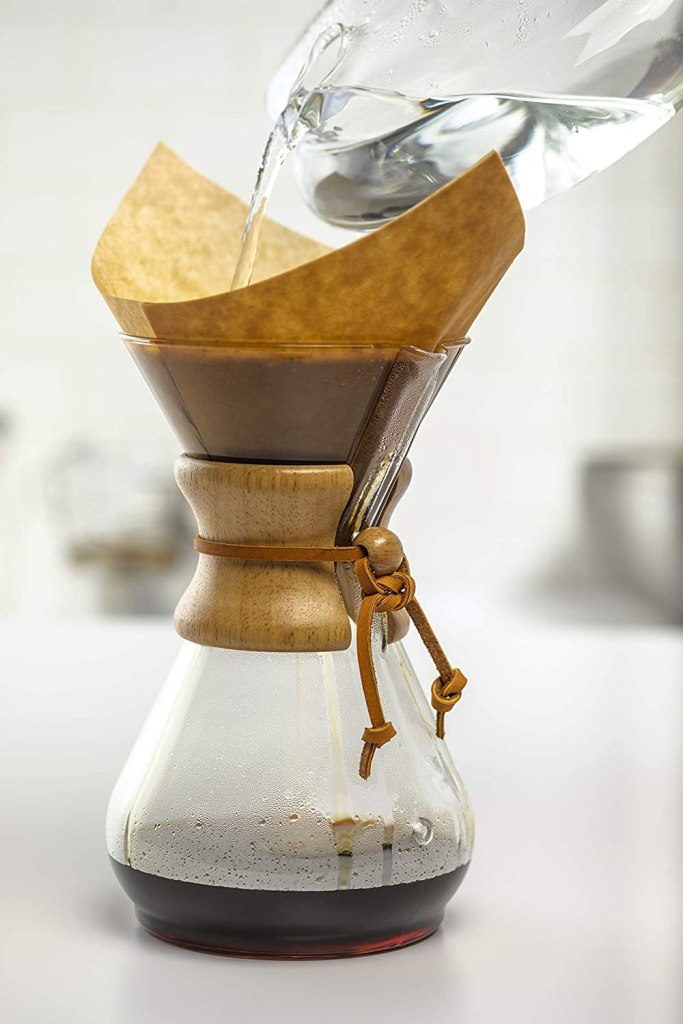
We won’t go over them all since doing so would require entire volumes. Instead, as a beginning point for investigating the brewer’s different capabilities, a basic approach to brewing with the Chemex is preferable:
- Insert the paper filter into the Chemex.
- Warm water should be used to wet the filter. Remove the water.
- Fill the filter with the necessary amount of ground coffee.
- Shake the Chemex a little to smooth out the grinds.
- Pour the water in concentric rings, beginning in the center and going outward, then allow the coffee to bloom: a word referring to the release of carbon dioxide gas from the coffee when it comes into touch with hot water.
- The amount of water used for the bloom should be around double that of the coffee.
- After the bloom has faded, continue to pour the water in little amounts.
- Allow the brewed coffee to thoroughly flow into the bottom of the Chemex after the pouring has finished.
- Pour it into your cup and enjoy it.
We said that the Chemex is multipurpose, and it also serves as a cold brew coffee brewer. The brewing procedure is identical to the one described above, however it is more simpler:
- Measure about 50g of ground coffee (for a 1:10 coffee to water ratio). Adjust the amount of coffee according to your favorite ratio and the size of the Chemex you have
- Put the coffee on the bottom of the Chemex. No filters
- Add the room temperature water. Stir the mixture
- Cover the top of the Chemex to avoid anything entering it during the cold brewing
- Let the coffee steep for anywhere from 12 to 24 hours, possibly in the fridge
- Once the extraction time is finished, use a paper filter over a large jar or bottle and pour the cold brew coffee from the Chemex in it
- It may need a while for the coffee to fully pass through the filter. Use a teaspoon to help moving the grounds and let the coffee pass quicker
- Store in the fridge or immediately serve
As you can see, the Chemex is an excellent hot and cold brewer. Light and medium roasted coffee beans benefit from the technology and quality of the bonded paper filters.
This produces beers that are extremely bright, clear, and crisp while preserving all of the original characteristics of these roast variations.
It also works well with darker roasts, however the resulting coffee is lighter and uninspiring. That is not always the intention of black roasted beans.
CHEMEX Pour-Over Glass Coffeemaker
Pros and Cons
This brings us to the Chemex’s benefits and drawbacks. The appealing tool’s main benefits are the good quality of coffee it produces and its appearance. Another benefit is the ease with which it can be carried anywhere, as well as its low cost when compared to other brewing systems of equivalent output quality.
It does not require any electricity to function. It is small enough to fit anyplace and simple enough to use for anybody. You have complete control over the extraction process by adjusting the grind size, water temperature, and pouring technique.
Speed and movements.
There are, however, a few negatives to consider. Glass is gorgeous, yet it may easily shatter if dropped.
The Chemex may last a lifetime, but it must be handled carefully.
It is not a device for people who want to brew a large amount of coffee and drink it over a few hours since it cannot keep coffee warm at all. It makes use of proprietary filters, limiting your options in this respect.
As previously stated, the Chemex prefers bright, light-bodied, and low-intensity coffee. Fans of powerful espressos or french presses may find the coffee “weak” or “unflavorful.”
It is essentially a brewing procedure that emphasizes some properties of coffee beans over others. You won’t get dark roasts, coffee with a lovely froth on top, or very strong coffee with a Chemex.
Who is the Chemex for?
While it is simple to make a cup of coffee with the Chemex, preparing a perfect cup requires time and practice. The Chemex’s large aperture, reliance on the correct coffee-to-water ratio, and how you pour the water make it a harsh machine.
A little too much water or the improper temperature might be the difference between a good cup of coffee and a poor cup of coffee.
The right grind size is significantly more important for a Chemex than for other operations. Keep a coffee notebook and record all the specifics of your brews to find out what went wrong with a certain coffee.
If you’re not willing to spend time experimenting with coffee and pouring procedures, don’t get a Chemex. This fourth attribute might also be considered as a plus, as learning about coffee can be quite interesting and pleasurable.
It’s up to you to decide if you want “quick and easy” brews or prefer to fail and learn from your errors in order to make a better cup the next time.
The Chemex is without a doubt a wonderful alternative for those who love light roasts, acidic, and bright cups of coffee. This brewer is intended for anyone interested in learning more about coffee.
How to fine-tune the brewing process to produce the greatest possible result for their preferences and tastes. For those who wish to think about it before drinking a beer.
The Chemex is both art and a coffee ritual in one, and people who respect both should consider purchasing one.
Individuals who want their coffee exactly the way they like it every time, without having to fiddle with settings or learn anything new, will struggle with a Chemex.
Only if you research and document your experiments will you have a terrific learning experience with reproducible findings. If you lack motivation, the Chemex may end up in the kitchen drawer sooner than you think.
 Small Coffee Place